

The bodycam footage of Stevie Lee's death is horrific. The Qld Coroner refuses to release it.
In 2021, a neighbour called the cops on a young Aboriginal man sitting in a car. Within an hour, he was pronounced dead. Now, his family continue their fight for justice.

This is the second installment in a week-long series into the police killing of Gungarri man Stevie Lee Nixon-McKellar.
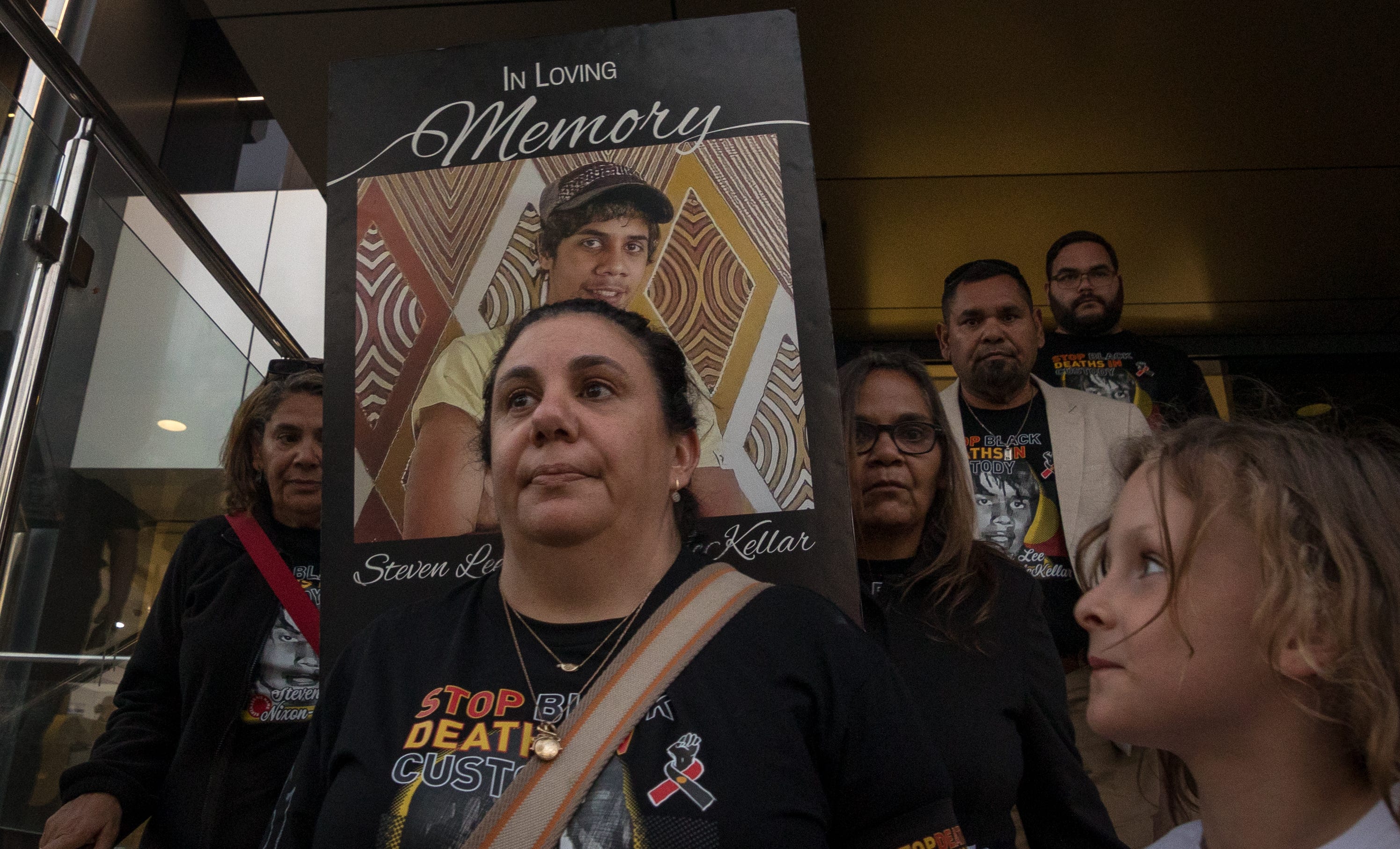
(Dr Raelene Nixon, and her family walk out of the Toowoomba court house on the last day of the inquest into her son’s killing by police. Image; Charandev Singh)
In February 2026, nearly five years after that day, the Queensland State Coroner Terry Ryan released his long-awaited findings into the police killing of Gungurri man Stevie Lee Nixon-McKellar.
The inquest had been held over a week in 2023 in Toowoomba, but the family had to wait nearly two years after that for Coroner Ryan to deliver his findings.
Rather than an in-person hearing, the coroner’s office had emailed the findings to Stevie Lee’s family on a Friday afternoon, meaning that it missed many of the major news bulletins, and also meant, that few media outlets aired the family’s response.
It has become a practice for the Queensland Coroner’s court to do this. Coroner Stephanie Gallagher also emailed the findings of Aunty Sherry Tilberoo’s inquest, who died in custody in a Brisbane watchhouse in 2020, to her family.
After the findings were released into Stevie Lee’s death, Toowoomba’s local newspaper The Chronicle posted a paywalled article on their Facebook page, which garnered over 1000 of mostly racist comments within two days.
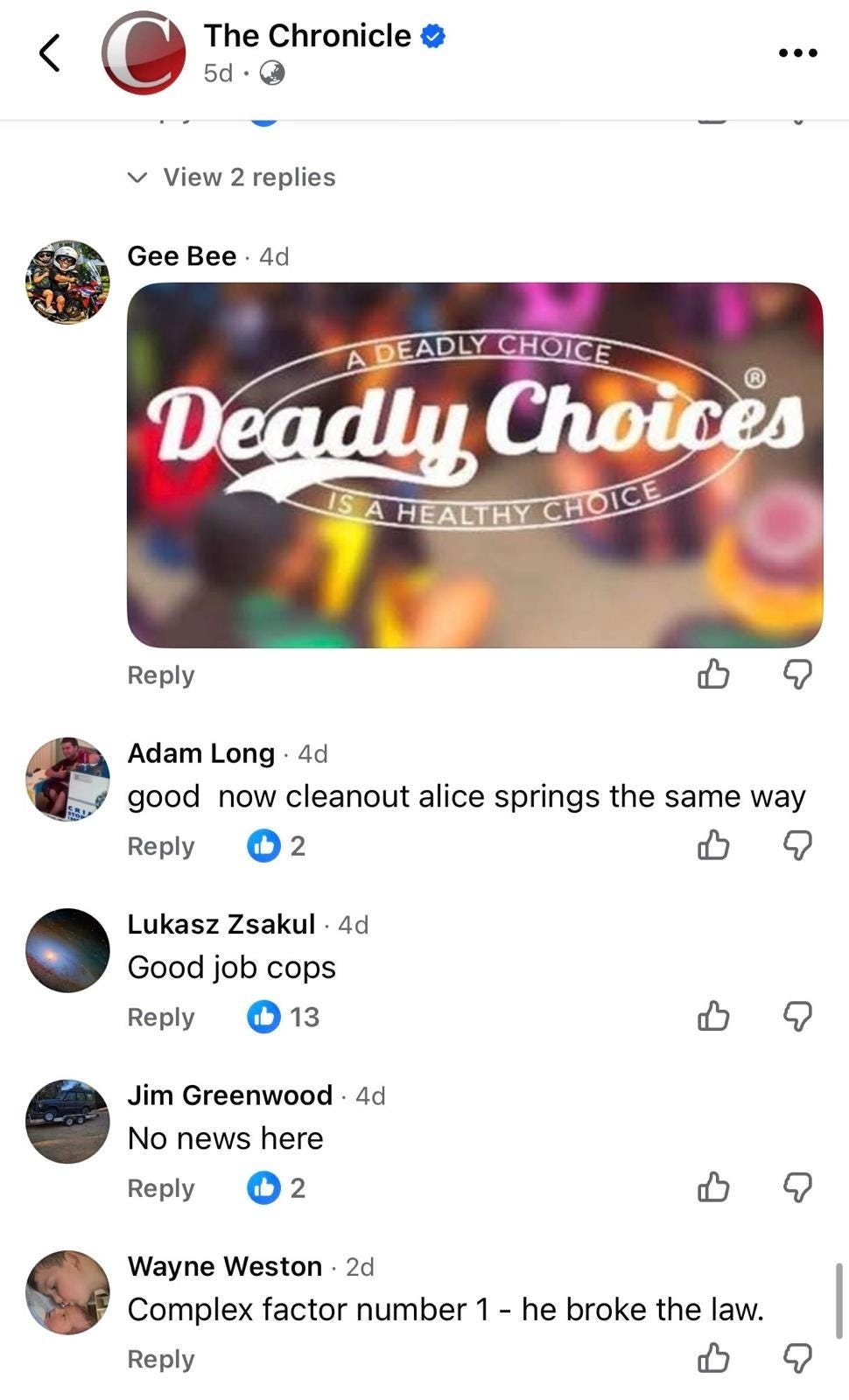
(A screen grab of racist comments on The Chronicle’s Facebook post about the death of Stevie Lee)
The commentors hadn’t bothered to read the article, or the inquest, or anything about the case.
Instead, racist Toowoomba - described as One Nation heartland, which recorded record ‘no’ votes at both the 1967 and 2023 referendums - claimed the killing of Stevie Lee was justified.
There was dashcam and bodycam footage of police actions leading up to Stevie Lee’s death, but in releasing the findings, Coroner Ryan also knocked back the family’s request to release this footage to the public.
Earlier this week, acting coroner Stephanie Gallagher knocked back another submission by the family calling for the footage to be released.
Coroner Gallagher rejected the family’s submissions within 48 hours, but accepted the submissions of the Commissioner of Police, stating that because the family had made serious allegations against the police officers who had killed Stevie Lee, then the bodycam footage would “mislead the public into forming unfair inferences and opinions in respect to the officers’ actions and the officers’ themselves”.
The Commissioner of Police had also submitted that the release of the bodycam would “further impact on the officers’ health and wellbeing”.
There was no similar care shown towards the family of Stevie Lee, and their “health and wellbeing”.
The family believe it is in the interests of open justice for the public to see the truth. For them to make up their own minds as to how their son, their cousin, their nephew, their uncle died, rather than rely on the narrative told by police and laundered through the coronial court.
The first time Dr Nixon saw the footage was at the Brisbane police headquarters, after Stevie Lee’s funeral.
Up until then, she had been told three things:
There had been a violent altercation. He had become unconscious. He couldn’t be revived.
But now, as she waited to see the footage, the police officer was telling her that she would see something else.
He told her she was going to view Stevie Lee being put in a restraint called a “Lateral Vascular Neck Restraint” and she had to take what she saw in context.
“He sat us down in a tiny room and told us what we were going to see was called a Lateral Vascular Neck Restraint. Before he played the footage, he opened with that,” Dr Nixon told Black Witness.
But he also said, “that’s not what killed him.’”
At that point, the family had not been given an autopsy. They had not been given a cause of death. Even then, it felt like the narrative had already been decided.
And so, Dr Nixon sat with her nieces and she watched the footage. It was horrific. It was shocking.
But there was something that also angered her.
“The audio wasn’t great on the footage, because it hadn’t been edited but I could hear the word ‘c**t’ and I said, ‘are they swearing at him?” she said.
But the police officer said that was Stevie swearing at the coppers.
“And I said, I know Stevie’s voice and that’s not Stevie.”
It was a lie. It wasn’t Stevie’s voice.
What she heard, as she watched her son dying on police bodycam, was the voice of Senior Constable Simon Giuliano, calling out to another police officer, Senior Constable Tyller Coleman:
“CHOKE THE C**T OUT”
Constable Coleman had then put Stevie Lee in a chokehold, which the police maintain is the Lateral Vascular Neck Restraint or LVNR, and Stevie Lee had collapsed onto the ground.
It later emerged at the inquest that Snr Constable Coleman was trained in Brazilian jiu jitsu.
Prior to being put in the chokehold, or ‘LVNR’, Stevie Lee had repeatedly said ‘help me, help me’, and ‘you got me’.
That day she saw the footage, Dr Nixon went straight to the airport, back to the plane back down to Victoria, her head filled with her son’s last moments.
It was one of the worst flights of her life.
When a police officer kills an Aboriginal person, they immediately start telling their own side of the story, and this story silences the stories told by black families.
This is true of Mulrunji Doomadgee, it’s true of Ms JC, it’s true of Kumanjayi Walker; it’s true of Mark Mason Snr, and it’s true of Daniel Yock.
Often, it is footage - whether bystander, CCTV or police bodycam - that can contradict these stories, and that can legitimate the voices of black families.
For example, the family of Ms Dhu - who died after suffering excruciating pain in a Port Hedland watchhouse - called on the coroner to release the CCTV footage of her last moments, in order to reveal callous disregard shown towards her both in life and in death.
The bystander footage of African American man George Floyd - who was murdered by a police officer - sparked a global movement for Black Lives Matter.
In the absence of the footage, the police stories will always make the victim out to be the threat by arming them with weapons and other implements*; by criminalising them and making them out to be ‘unworthy’ or even claiming they are so ill that they have died of ‘natural causes’; and these stories seep from the mouths of police and their PR machine to press conferences to media statements to news reports to coronial inquests; which is what happened with Stevie Lee Nixon-McKellar, whose family, were never given the right to tell their side of their story, and who were silenced again by the inquest process and then Coroner Ryan’s findings.
Coroner Ryan not only refused to release the bodycam footage, but his findings also absolved police of any wrongdoing.
He found Stevie Lee had suffered a cardiac arrest, and that the cause of death was ‘multifactorial’.
In the findings, Coroner Ryan said it could not be determined which factor caused Stevie Lee’s death - whether it was the neck restraint, whether it was the baton being applied to his abdomen, whether it was the physical and psychological exertion, or whether it was Stevie’s underlying health conditions.
It was not dissimilar to the police officer’s instructions to Dr Nixon on the day she first saw the footage. The police narrative had not changed, even after an inquest.
During the inquest process, the family were repeatedly denied their right to tell their story, and the lasting image of Stevie Lee was one limited to his records as constructed by those who were surveilling and criminalising him: the health and ‘justice’ systems.
“I talk about the inquest being one of the most expensive theatres I’ve been to,” Dr Nixon said.
“It was so well rehearsed and scripted, and so controlled. We knew when we went in there that there would be nothing really there for us.
“The counsel assisting was so strict about what she would or wouldn’t allow, and now we have seen the findings, we can see that the coroner has just selected what they would or wouldn’t allow there anyway.”
At the end of the week, the family were also told to censor their family impact statement, and as negotiations around this censoring went on for an hour and a half, Dr Nixon had decided to pull the statement entirely.
“I afforded every other speaker the opportunity to voice what they believe happened here and our family has not been offered the same opportunity,” Dr Nixon told a press conference at the time.
The inquest concealed the reality of racist violence in the town, and the fact, at the end of the day, all Stevie Lee was doing was sitting in a car, while sick, and while black.
This was the side of the story that the coronial findings will not tell; that the court and the coroner refused to hear.
It is the side of the story shown in the bodycam footage, which when shown at the inquest, prompted members of Stevie Lee’s family to cry out in disgust, and for one of his grandmothers to say loudly:
‘Cruel. Very cruel’.
What was on the bodycam footage? The third installment of the #JusticeforStevieLee series will be published tomorrow.
*I refer to these framings as ‘imaginary spears’: the ways police and media arm Aboriginal and Torres Strait Islanders with implements and weapons to construct an image of them as a ‘threat’; even when it is the police officers who hold the guns and batons.
To read the previous stories, click on the links below:
His spirit went home: The death in custody of Stevie Lee Nixon-McKellar
In the meantime, you can support the family’s campaign to release the bodycam footage of his death, by signing the petition.
Please keep writing these. The truth is so important to be told.
Thank you Amy for keeping this important fire burning. Very much appreciated.