


Over the past few months there has been a lot of panic over the popularity of Pauline Hanson’s One Nation.
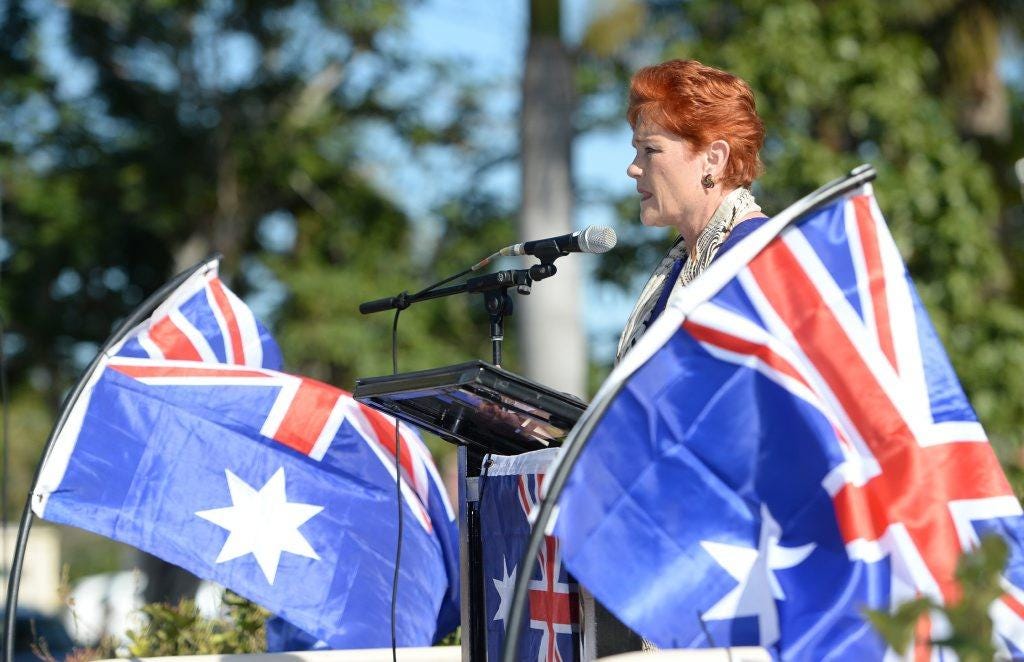
(One Nation leader Pauline Hanson)
Several polls have shown her polling higher than the Coalition, and at times even the ALP.
The commentary has been so feverish that some have described the rise as “meteoric” or “stratospheric”.
But maybe it’s time to bring some of these fellas back down to earth, and what better time to do it than in NAIDOC Week.
There have been thousands of words written, hours upon hours of podcast opining, numerous short Instagram Reel ‘fact-checks’, a National Press Club stunt and the usual dross masquarading as ABC ‘expert analysis’.
Most of them, when they are right, are right for different reasons, but all of them are overwhelmingly wrong for the same reason.
Every piece of analysis erases two key parts of the One Nation story - one, the significance of Queensland, and two, the very reason Queensland is significant in the first place, and that is due to its particular brand of white supremacist anti-Indigenous racism, which it has exported not just nationally but internationally.
These erasures are not innocent; they are deliberate.
For example, there was much debate about Hanson’s call for a ‘monoculture’, with many commentators arguing across three broad points.
1. It’s impossible, and no society in the world has a monoculture.
2. It’s ‘ridiculous’ and just part of Pauline’s playbook (hello Annabel Crabb),
or the more common one:
3. Look at the Socceroos!
But few have elaborated on what a monoculture actually means. Most state that Hanson’s calls for a monoculture are against multiculturalism, which seems to make sense semantically, until you realise the direct target is not multiculturalism but rather the constant threat of Indigenous presence.
A monoculture is oppositional to multiculturalism in the same way a mirror is; these two concepts are just two different sides of a settler colonial fantasy projecting the same imagining: both rely on the erasure and displacement of Indigenous peoples from Indigenous lands, and both silence what Professor Irene Watson calls the ‘unspeakable’: Indigenous sovereignty.
Hanson’s call for a ‘monoculture’ is another call for the destruction and erasure of Indigenous nations and sovereignty over a land we have had custodianship over for numerous millienia.
The fact that the waves of analysis from either the progressive to the centre to the conservative seem to erase One Nation’s anti-Indigenous racism, despite it being foundational to the party and its success, attests to this.
It’s this settler colonial fantasy and these nationalistic imaginings that have given rise to One Nation not over the past few months, or years, but rather over 30 years.
And the rise has much to do with the specific racial violence in the state of Queensland, and how it is built upon the oppression of Indigenous peoples and continual land theft, from which all other forms of racism, including the racism fuelling anti-immigration sentiment, emerge.
Even weeds need specific conditions to grow, and it just so happens that One Nation thrives particularly well in the blood-soaked soil of Queensland.
For all the hysteria over polling, it has been Queensland where One Nation planted itself, in Queensland where it grew, and in Queensland where it has spread like lantana.
After taking back One Nation leadership in 2014, Hanson was elected senator for Queensland along with Malcolm Roberts.
Hanson then ran several candidates across regional Queensland and around the country at the 2019 federal elections.
In my home town of Rockhampton, which is in the electorate of Capricornia, we had a choice between a third-generational coal miner for the ALP, the LNP, One Nation, Bob Katter’s KAP, Clive Palmer’s United Party, Francis Anning’s party, and, The Greens.
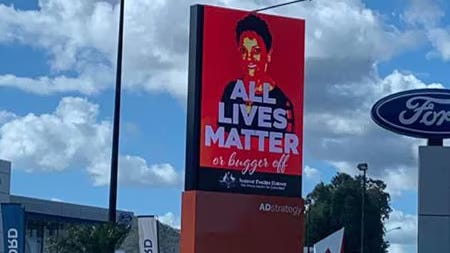
(A One Nation sign on a major Rockhampton road in 2020).
At the time, I thought the fact we basically had a smorgasboard of conservative parties would split the vote for One Nation, but the party did very well.
That year, One Nation’s candidate won 15 percent of the vote, and Capricornia was not an outlier that election.
Across Queensland, One Nation polled 8.9 percent, and of the 14 seats where One Nation polled higher than 10 percent, 11 were in Queensland, according to analysis by Antony Green.
In February this year, Green wrote another analysis of the seats that One Nation could potentially win in the next election, based on the party’s results in the 2025 federal election.
The first six of those seats were in Queensland, and these were seats where she has consistently polled well.
The top three that Green considered would be vulnerable to One Nation due to the lowest Three-Candidate preferred vote for the winning candidate were:
Wright: which takes in Logan towards the Lockyer Valley in Queensland.
Longman: which takes in Caboolture on the Sunshine Coast.
Capricornia: which takes in Rockhampton and up towards Collinsville and out west to Dysart.
Flynn: the neighbouring electorate to Capricornia, taking in Gracemere, Blackwater and Eidsvold.
Hinkler: which takes in Bundaberg and Hervey Bay
Wide Bay: which takes in Maryborough, Gympie and Noosa.
Out of the 25 electorates Green considers most vulnerable to One Nation, 12 are in Queensland.
We know that One Nation started in Queensland, and we also know that the very reason One Nation exists is because Pauline Hanson was disendorsed by the Liberal party at the 1996 Qld State elections when she wrote racist things about Aboriginal and Torres Strait Islander people in a local newspaper.
That election, Hanson went on to win the safe Labor seat of Oxley, in Ipswich, with a swing of 19.3 percent as an independent.
It was obvious many agreed with her.
Since then, her racism towards Blackfullas has remained consistent, although this racism is continually silenced in the feverish commentary that accompanies her current positions in the polls, despite the obvious fact that polls are notoriously unreliable.
What is reliable, however, is the tenacity, intensity and longevity of anti-Indigenous racism, because all of these seats I mentioned are in One Nation heartland.
I quantify these seats as the most racist in the country not just by the ballot box but also in the number of One Nation posters and Australian flags I count going up the Bruce Highway.
And by racist, I specifically mean, racist towards Blackfullas.
This is not just because I know the reality of racism and racist violence in my hometown of Rockhampton and neighbouring electorates, but also because in 2023, two years before the federal election, we had a referendum that gave us a clear indication of where the beating heart of anti-Indigenous racism is in the entire country.
The Voice referendum provides us with a barometer for racism by geographical area.
In the three years since the ‘NO’ vote gave racists a mandate to be racist, we have seen an explosion in outright racist commentary and acts in these areas.
For example, I have already seen shocking examples of racist remarks on NAIDOC posts in Rockhampton and Pauline’s former stomping ground of Ipswich.
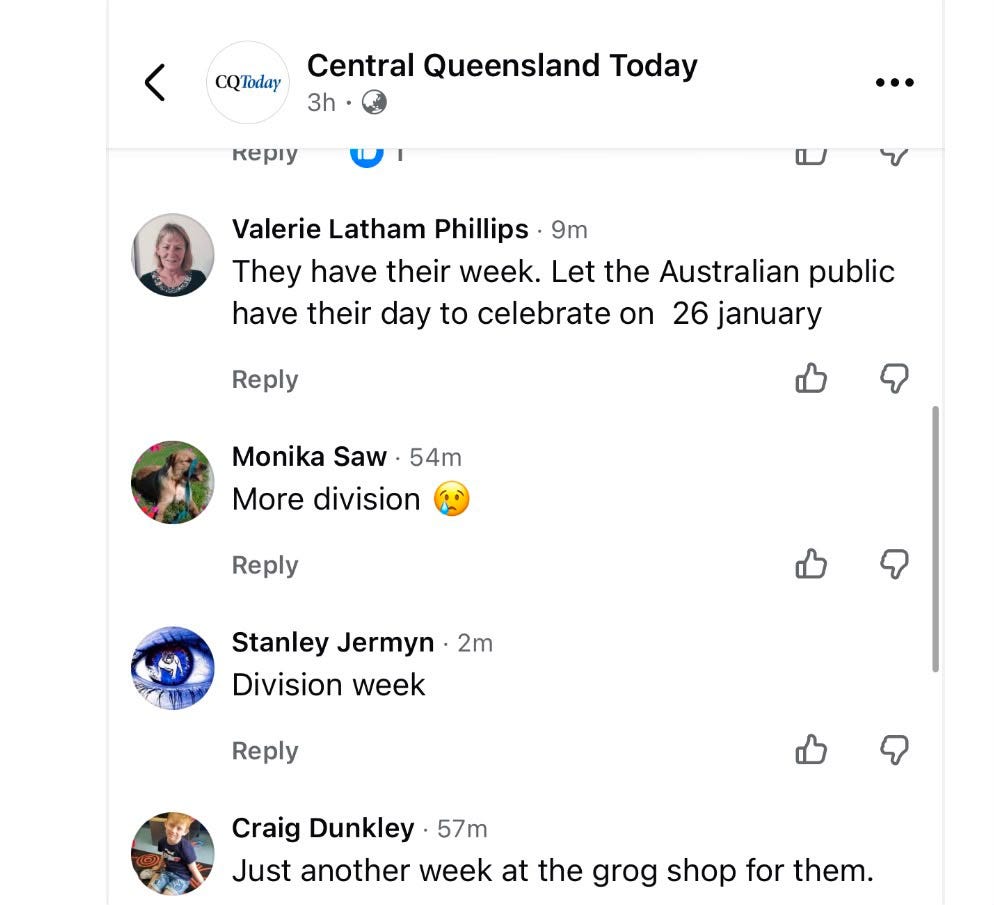
(One selection from the numerous racist comments on a recent NAIDOC post in Rockhampton)
Queensland was the state that recorded the highest percentage of ‘No’ votes in the country, the place where One Nation was birthed and remains strongest.
The seats that have a high One Nation supporter base are also the seats that recorded the highest No votes; there’s a direct correlation between the ‘No’ vote and One Nation voters.
Don’t believe me?
In Wright, 77.3 percent of people voted No.
In Longman, it was 75.3 percent.
In my home seat of Capricornia, it was a shocking 80.7 percent.
In neighbouring Flynn, it was 83.43 percent.
In Hinkler, it was 80.43 percent.
In Wide Bay it was 74.8 percent.
In Maronoa, which also has a high One Nation presence but which is also the seat of former Nationals leader David Littleproud, voters recorded the highest No vote in the country, at 84.62 percent.
This is not a coincidence. And it says something about One Nation and Queensland that has been erased from the discourse, because it was not just white settlers who voted ‘No’ to giving Indigenous Australia anything, even if it was the most unoffensive, palatable requests (a non-binding Voice), but also many settlers of colour.
Which brings me to the other point I wanted to make about the panic and fear.
Despite the fact Pauline Hanson and One Nation have been a formidable political force in these regional and racist Queensland seats for a very long time, you would think, based on the southern media, that the threat only emerged recently, when it arrived on their doorstep.
It’s what makes the sudden burst of outrage and righteous indignation so offensive while also revealing how shallow it is.
The reality is, One Nation has not just popped up overnight and the threat posed is not some distant, dystopian future.
To Blackfullas, she has already wrought enormous damage over the past three decades.
Pauline Hanson’s attacks on Aboriginal and Torres Strait Islander people in the 90s allowed Prime Minister John Howard to unleash his own bureaucratic violence upon Indigenous policy.
He attacked land rights, he abolished ATSIC, he defunded successful Indigenous programmes, he passed draconian laws.
All of these measures had disastrous impacts on policy and had their genesis in the racist rhetoric of Pauline Hanson, which allowed Howard’s racism to appear reasonable and politically palatable.
The Libs disendorsed Hanson for her racism toward Blackfullas but ended up using her as a cover to get away with doing the same thing she called for.
Today, Blackfullas still feel the brunt of those attacks. We’ve never come close to another ATSIC, or to true land justice.
In fact, it’s obvious Indigenous policy has gone backwards and the referendum has only intensified the racist attacks towards Blackfullas.
It’s unlikely a candidate like Hanson would be disendorsed today over the same racist comments she made in 1996, because we’ve seen time and time again how it is politically popular and even advantageous to bash Blackfullas.
The LNP were recently voted into Queensland on this very platform, on a promise they’d lock up more black kids.
The racist violence is now so overt and the silencing so intense that Queensland’s LNP government has a strategy called ‘project invisibilty’, which the Guardian says is designed to “purge the public sector of First Nations officials, policies and programmes”.
It’s no coincidence all this comes from Queensland, and it’s no coincidence as well that the media, from all sides of politics, silences this in itself, because to conceal the racism of Queensland is to conceal how this racism emerges from the continual oppression of Aboriginal and Torres Strait Islander people.
And it’s this point that is most important because despite all the analysis about the far-right, of the Karl Stefanovics and Kyle Sandilands, and the internet bots and ‘fake news’ and algorithms, the fact remains that Pauline Hanson’s rhetoric is not new but based on a specific imagining of a society that aspires to a White Australia.
And in Queensland, this particular racist nationalism is most intense. It is a settler fantasy of a white nation, in which the first targets are always, and has always been Aboriginal and Torres Strait Islander peoples.
Happy NAIDOC Week.
Grew up in Maranoa electorate - racism is baked into the culture in QLD. How are people surprised that PH has so much support here and more nationally? The racism has always been there. And total confusion about the difference between patriotism and (white) nationalism. The flags make me feel like I’m back in trumps America. 🤮
Didn’t realise you were from Rockhampton. I lived up there for a number of years about 16 years ago and it was so evident how racist the town was.