

It all happened so fast, but justice moves so slow: The death in custody of Stevie Lee Nixon-McKellar
In 2021, a neighbour called the cops on a young Aboriginal man sitting in a car. Within an hour, he was pronounced dead. Now, his family continue their fight for justice.

This is the third story in the series on the police killing of Gungarri man Stevie Lee Nixon-McKellar.
So what happened on that day, on 7 October 2021, on Stone Street in Wilsonstone, the day that Gungarri man Stevie Lee Nixon-McKellar was killed by police?
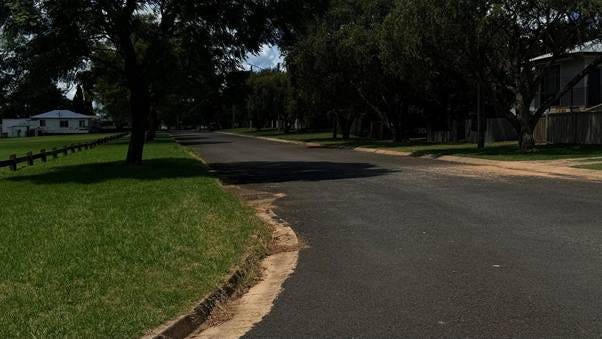
(Stone Street, Wilsonstone in Toowoomba).
It all happened so fast, within 40 minutes.
For Stevie Lee, it was only supposed to be a short stop on his way home to Mitchell, a four-and-a-half-hour drive inland from Toowoomba.
He was with three other young men, when they pulled up to the driveway of his aunty’s house in Stone Street.
“Steven had pulled up at (his aunty’s) house to put water in the radiator. He was getting the hose and moving the car a little bit closer to get the hose to reach it. That’s what he was doing, just getting some water,” Aunty Lynette says.
“And his cousin, who was in the car with him, was inside. They were waiting for him.”
Unbeknownst to Stevie, there was a person watching.
A neighbour had looked out at the street and had seen what they considered was a suspicious vehicle parked in front of a house.
It was suspicious because of the occupant. There was a young Aboriginal man - Stevie Lee - sitting inside.
And so, the neighbour looked up the license plates online, finding out they were expired and registered to another vehicle. They picked up the phone.
At 12:21 pm, they called the police, reporting they had seen quite a young Aboriginal man get out of (the car) and it didn’t look quite right.”
Eight minutes later, at 12:29 pm, the call was sent out over the police dispatch:
A young ATSI (Aboriginal and Torres Strait Islander) driver, grabbing a bag out of the car, unknown if they were going into a house on the street.
At the inquest, the family’s lawyer, Stewart Levitt, told the court that:
“It’s my submission that the entire incident arose out of racial profiling, because at 1:07 pm, at the end, the police did not know the name of the person who had died.”
It all happened so fast.
In the next street over, there were two cops - Senior Constable Simon Giuliano and Constable Brandon Smart.
Neither of them knew who Stevie Lee was, and neither of them had had interactions with him before.
It took them one minute to get to Stone Street, where they immediately saw the vehicle.
They drove down and parked directly behind the car.
At this point, neither police officer turned on their body cam, but there was dash cam footage from the police van.
It was here, that the two police officers both said the car moved back and forth. They claimed it made them fearful, that they thought they would be ‘rammed’.
Stevie’s aunt Saraeva Mitchell spoke to the other young man in the car afterwards, who provided a different version of events.
“He said, Stevie froze. He didn’t know what to do. (The cousin) put it in reverse, and Stevie hit the accelerator, that’s why it went back and forth.”
Back home in Mitchell, Stevie had never resisted arrest and was not known to be violent.
“If you ask any of the police here in Mitchell if they wanted to arrest him, he would put his hands up and let them put the cuffs on him. That’s how he was,” Aunty Lynette Nixon says.
But this movement, back and forth, was what was used to justify what happened afterwards.
The two police officers, and the police officer who reviewed the footage, claimed the two cops thought they were in danger of injury and the incident was now ‘high risk’.
At the inquest, the family’s lawyer Mr Levitt questioned the officers several times about whether they were actually in any danger.
At the inquest, Constable Smart agreed that neither Stevie Lee or the other occupants in the car had tried to ram the officers, that they had not even come close to ramming them, even though Stevie Lee had been in the driver’s seat and had the opportunity to do so.
Despite claims the police were in fear of their lives, that they were in danger of injury, the car had not rammed them at all.
It had not even come close.
But it all happened so fast.
Because he claimed he was about to be rammed, Constable Smart said he got out of the rear of the police van, and immediately went to the front passenger window, where he claimed he checked the door, and it was locked.
He claimed that he mouthed and motioned to the person in the passenger seat to get out.
And then, he said the car moved forward further into the driveway, towards the house.
Constable Smart drew his baton, and despite the fact he claims he was in danger of being rammed, he walked behind the rear of the vehicle.
“The fact is, you weren’t seriously worried about being rammed because you walked right behind the car that you said you thought was going to ram you,” Mr Levitt countered at the inquest.
“I disagree,” Constable Smart responded.
At this point, he did not turn on his body cam footage, claiming at the inquest “quite frankly it was not on my mind”.
He moved towards the driver’s window and without checking that the door was locked, began smashing the window with his baton, bang bang bang, three or four times.
The window shattered.
Inside, was a scared, and sick Stevie Lee, who could not run as fast as the others.
He was never given the opportunity to comply with police directions before the police officer started striking the window with his baton.
The driver’s side door was unlocked, but Constable Smart had not bothered to check.
“Stevie was left in the car because he was too sick to move,” Dr Nixon says.
It all happened so fast.
The window shattered, and Stevie Lee moved towards the passenger seat, away from the glass shards, and as he exited the vehicle, at the passenger side, he was intercepted by Senior Constable Giuliano, who says Stevie Lee “came out quite rapidly and we become entangled. We initially went to the ground”.
He told the inquest that Stevie Lee was trying to get away from him, and that he tripped over his left leg, causing them to tumble to the ground.
Constable Smart again walked behind the rear of the vehicle towards the passenger side.
He still had his baton out, and he walked towards Stevie Lee and Snr Constable Giuliano. He still did not know Stevie’s name at this point, or his identity.
He used his baton and struck Stevie on the quad several times; and then when he claimed that didn’t work, he wrapped the baton around Stevie Lee in a bear-hug-esque fashion.
It meant Stevie Lee could not comply; he could not move, he was trapped in the bear hug, which is not a technique usually used by the QPS.
At this point, Stevie Lee was struggling; it had all happened so fast, but despite his sickness, the officers claimed he was ‘strong’ and was holding onto Senior Constable Guiliano’s baton.
Constable Guiliano attempted to strike Stevie Lee twice again with the baton.
It was all happening so fast.
Stevie Lee was crying out ‘you’ve got me’ several times, and ‘help me’ and again ‘you got me’.
He was being held up by the baton, that’s why he couldn’t get down on the ground” Ms Mitchell says.
At this point, Stevie Lee was exhausted, speaking in “exhausted breaths”.
At the inquest, Mr Levitt put it to Constable Smart that Stevie Lee couldn’t get down on the ground because he was being restrained in a position where he couldn’t do so, which Constable Smart denied.
But before the next part, before the chokehold was applied, Stevie Lee had already said several times you got me.
All three were exhausted, but the officers still claimed Stevie Lee was strong.
By that point, another officer had arrived - Senior Constable Tyllar Colman, who trained in Brazilian jiu-jitsu. He had responded to a code 2 and was on the scene where he saw all three - Stevie Lee and the two officers struggling against the car.
It was here that Constable Smart yelled out he’s got the baton, Stevie Lee said oh no, and then Senior Constable Guiliano said:
CHOKE THE C**T OUT, CHOKE HIM OUT
Constable Smart did not repeat those words in the interview transcript after the death, claiming he did not recall at that time.
It all happened so fast.
Constable Colman came in and applied what the police call a Lateral Vascular Neck Restraint, a type of chokehold authorised by the QPS.
As the officer applied the chokehold, Stevie Lee went limp, Senior Constable Guiliano said he’s asleep, he’s asleep, let him go, and Stevie fell to the ground unresponsive.
At this point, as CPR was about to commence, Constable Colman yelled for the officers to put the cuffs on Stevie, but then another officer had said don’t worry about it start CPR.
CPR continued for 32 minutes. Stevie was pronounced dead at 1:07 pm.
From the police arriving, to Stevie Lee dying: it was only 37 minutes.
It had all happened so fast.
But the wait for justice; so long, so tiring; is always so slow.
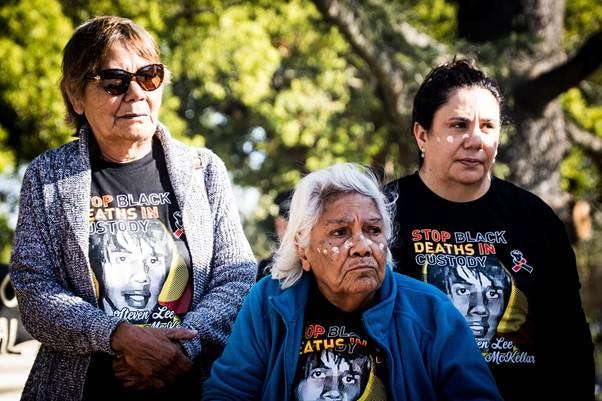
(Stevie Lee’s grandmothers Valma McKellar, Aunty Lynette Nixon and his mother Dr Raelene Nixon. Image: Charandev Singh)
It had all happened so fast, that that Stevie Lee’s aunty, who was inside the house, did not see what happened.
As Stevie Lee lay on the street, she called Aunty Lynette in Mitchell, who called Dr Nixon in Victoria, who jumped out of a Zoom meeting with her PhD supervisors with a sense of foreboding because her mother never rang her at that time, and immediately heard the panic on the other side.
“She said Steve’s in trouble. I still can remember the words, the tone, the panic. I said, ‘what’s happened?’ and she said, our cousin had just phoned and told her that Stevie had been bashed by police, and she doesn’t know what happened to him.”
Dr Nixon phoned her cousin and asked her if her son was okay.
“She said, I don’t think so sis. She said, I don’t know what’s happened, but they have put a white sheet up the front.”
Dr Nixon then asked to speak to the police, and so her cousin took her mobile phone out to a police officer; he had previously served out at Charleville, which is not far from Mitchell.
“I asked him, can you tell me what happened?
And he said “No I can’t.
And then I asked him, “Can you just tell me if my son’s, ok?”, and he said:
“Well no, he’s not.
“And I asked him, has he been taken to the hospital, because my cousin saw the ambulance there.
And he said:
‘I can’t give you any medical information because I can’t confirm your identity.
“And then he said I’ll have someone from Victoria come to your house.
“And then he turned off my cousin’s phone,
“And he didn’t give it back to her.”
This was one of the first silences; one of the first periods of waiting.
Because the cop had taken her cousin’s phone, Dr Nixon’s family had no choice but to begin ringing around every hospital, asking if Stevie Lee had been admitted, and to the Toowoomba police station.
They rang the local Aboriginal Legal Service in Toowoomba, as well, but were told there was nothing they could do, until police notified them that he had been arrested.
“I said: He hasn’t been arrested. I think he’s dead. Can you please send someone to check?”
The family would only find out later, that Stevie Lee was never taken to the hospital.
He remained on that street for eight hours and was taken to the morgue, where his family could not see him for seven days.
He was never under arrest.
Stevie Lee had died while sitting in a car in his aunt’s driveway.
Like George Floyd, who had been murdered on a street an ocean away from Stone Street, Wilsonstone; Stevie Lee had also died for being black and for being visible.
But unlike the murder of George Floyd, which rightly drew international condemnation, what happened to Stevie Lee is silenced and the Coroner and the police want his family to move on.
From the very beginning, Stevie Lee’s family have campaigned for two measures as a way to fight for justice.
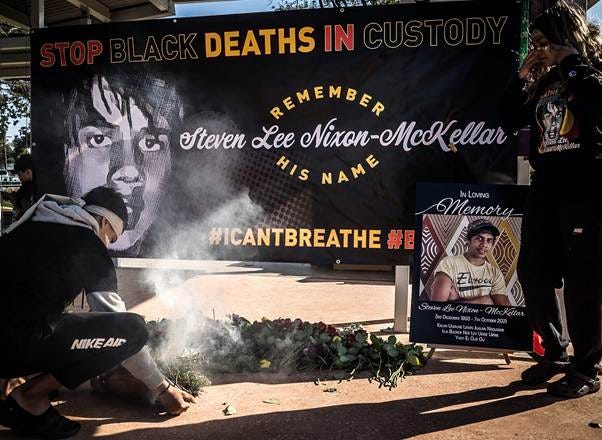
(Image: Charandev Singh)
One of those measures is a ban on the use of the LVNR.
According to Yuin academic and policing historian Dr Amanda Porte, “Queensland is currently the only state in Australia to allow the controversial chokehold”.
The then QPS Commissioner Katarina Caroll had removed the chokehold as a use of force option for the QPS in April 2023, Dr Porter wrote in the National Indigenous Times.
”Just one month later, Commissioner Caroll reneged, stating pressure from the Queensland Police Union, who challenged the ban, arguing it prevented officers from defending themselves. The LVNR is currently allowed in ‘dangerous situations’.
The other mechanism for justice would be the release of the bodycam footage, that would show the public the truth about what happened to Stevie Lee.
In releasing his findings, Coroner Ryan called on further submissions about the release of the footage.
But within 48 hours of those submissions being made, acting state Coroner Stephanie Gallagher knocked them back, instead siding with the Police Commissioner, that the footage would be viewed out of context.
Coroner Gallagher had stated that the releasing the footage to the media was not “in the public interest”. She accepted the submissions of the Commissioner of Police, which included that the footage would be taken out of context and it involved officers “attempting to lawfully detain Steven using reasonable, and lawful, use of force”.
She also accepted the Commissioner’s claim that releasing the footage to the media would “further impact on the officer’s health and wellbeing”.
But that excuse does not make much sense, or give much consolation to the family of Stevie Lee, and those in the coroner’s court who witnessed the footage of his last moments at the inquest.
It does not make much sense when Stevie’s only crime was to be sitting in a car while sick, when it all happened so fast that Stevie Lee had no chance, that his last words, before a chokehold, was one of surrender: you got me you got me, said not once, but several times.
“Releasing the body-worn footage is essential for transparency and accountability. It allows the public to see for themselves the events as they unfolded,” Dr Nixon says.
“The is concerned the footage may be taken out of context.
“But I know it provides a clearer picture of the circumstances surrounding his death. Stevie Lee has been painted as a scary villain who was destined to die, yet in the footage you hear him saying help me help me help me. You got me you got me you got me.
“You will see in the footage that it doesn’t align with what you will read in the report.
“It’s critical for our family as we seek justice and understanding.”
It all happened so fast; and yet now, justice is all too slow.
To read the previous stories, click on the links below:
His spirit went home: The death in custody of Stevie Lee Nixon-McKellar
The bodycam footage of Stevie Lee’s death is horrific. The Qld Coroner refuses to release it.
In the meantime, you can support the family’s campaign to release the bodycam footage of his death, by signing the petition.
Horrific racism at all levels. Thank you for sharing the story. Condolences to Stevie’s family. This should never have happened.
Awful awful awful